25/10/2013

No Rush - October 3rd

I watched Marijke's videos on how to slow down a rushing horse, because in our last two training sessions Karina started to rush forward instead on moving slowly and with precision, which is so important in the beginnings of ST. That video explained me a lot: now I know that I'm dealing with the strong, straight and pushing hindlegs. My idea to incorporate working on poles and cavalettis in our groundwork seems now to be even better. I must have known instinctively what I'm dealing with, and hence the idea of cavalettis. Last year, when I was riding Karina, I tried to do some work on poles, but Karina, though at first seemed to like it, soon started rebelling against it. At that time I didn't know why, I thought that I've put too much strain on her and that she might be bored (though I changed the configuration of poles and cavalettis pretty often to keep her interested). Now I know that that was not the cause, or at least not the main cause.
Marijke says that we who work with a rushing horse should be prepared to stop him every time we feel that the horse starts to push with his hindlegs instead of carrying himself. That may mean that we'll have to stop after each step, but at this stage precision of every movement is crucial for the further training. We should even be prepared to back the horse up, if stopping doesn't help and the horse starts walking into us. The horse is not being mean or disobedient, he's just trying to deal with his new situation in the only way he knows. And it is up to us to help him find himself. Even if it means stopping him like forty times in our ten minutes' training session. Well, nobody said that it's going to be easy, but they said that it's going to be worth it...
That is just so great that I have found a source of information on any trouble that I may meet while doing groundwork with my horse. Marijke is sharing her knowledge very generously, and very skilfully. For example, Gerd Heuschmann is propagating the same knowledge, but he's often being too hermetic. Well, the fact is that we who are working with the horses really should go through the same sources where he did his research on proper horse training, and perhaps then we would understand him better. But not everybody can get to those resources, as most of the old riding masters' works are written in German or French, and here in Poland they are either totally inavailable or horribly expensive. I know, I know, that is not an excuse. I just know how much I have still to do, to learn, to find out, that I sometimes feel overwhelmed by that and start moaning :) I would love to get down to The Gymnasium of the Horse by Steinbrecht or to works of Pluvinel. And I hope that one day I will, and in the meantime I just have to go through other resources that are available for me at the moment...

22/10/2013

ST Session - October 2nd

This time Karina was quite happy to see me. As soon as she had noticed me coming through the pasture, she headed towards me. Without any protests she went with me to the stableyard to be groomed. She didn't like her left front leg to be cleaned, because her hind left hoof is sore due to the thrush, which is being cured. Wet pastures and sweet hay do not help us to heal it, but I hope we'll succeed.
I forgot to play with Karina's tail this time, which is maybe as well, because she seemed to be over excited, just as if she was going to be in heat soon. Anyway, I dressed her up in the cavesson and away we went for a walk in the fields. I worked a little on head lowering and stelling. Now it seems to me that I should have worked on stelling much more, and should have started in a standstill. We tried a little shoulder forward movement, which worked quite well on one side, but on the other was much worse. That is not surprising at all, considering that Karina has her right side muscles so short and stiff.
Then we went to the riding arena, which unfortunately is covered all in nice grass and Karina couldn't focus so well as in the sandy roundpen. Anyway, we started working on the poles, and again I've made some mistakes. I should have kept a better eye on Karina's LFS during those exercises. Instead I walked on her outside and I couldn't control the inner hind leg. But it seems to me, now that I have watched our training video, that she starts to control that herself. She didn't lean so much on her right foreleg and she nicely stepped under with her right hind leg. That is not yet good enough, but it seems to me that we're getting somewhere. I walked with her three times over four poles lying on the ground and four cavalettis that were lifted just a little (10 cm, not more). That exercise I've found in a book 101 Dressage Exercises for Horse and Rider by J. A. Ballou. In the book that is of course a riding exercise, but nevertheless it's easy to change that into work in hand exercise. As the author states, this exercise (no. 10 in the book) helps to relax the lumbar part of the spine and brings more life to the horse's back. And Karina needs that badly...
After three rounds over the poles and cavalettis we changed direction and went another three rounds. Three times seems to me just optimal, because on the first time horse makes some mistakes, as it has to learn where exactly the poles are placed. Second time, Karina always tends to rush on them (out of excitement perhaps), and on the third time everything is just fine and the horse is not bored with the exercise yet. Always stop on the top :)
Then we worked a little on backing up, which though it is not yet on the straight line, but starts to look much better. Karina lifts her feet instead of dragging them backwards and lifts them diagonally just as she is supposed to do. This we did three times on one side and three on the other. After each backing up I asked Karina to move forward and that she did eagerly, with impulse. I've noticed not maybe a huge change in her movement, but a visible one. Her halts are becoming much better – she stops with her weight more on her hind legs, and not so much on the front. I hope this will keep improving...
Then we went to dress her up in her stable halter again and we went to search for some apples that have fallen from the trees. That was the end of our training.
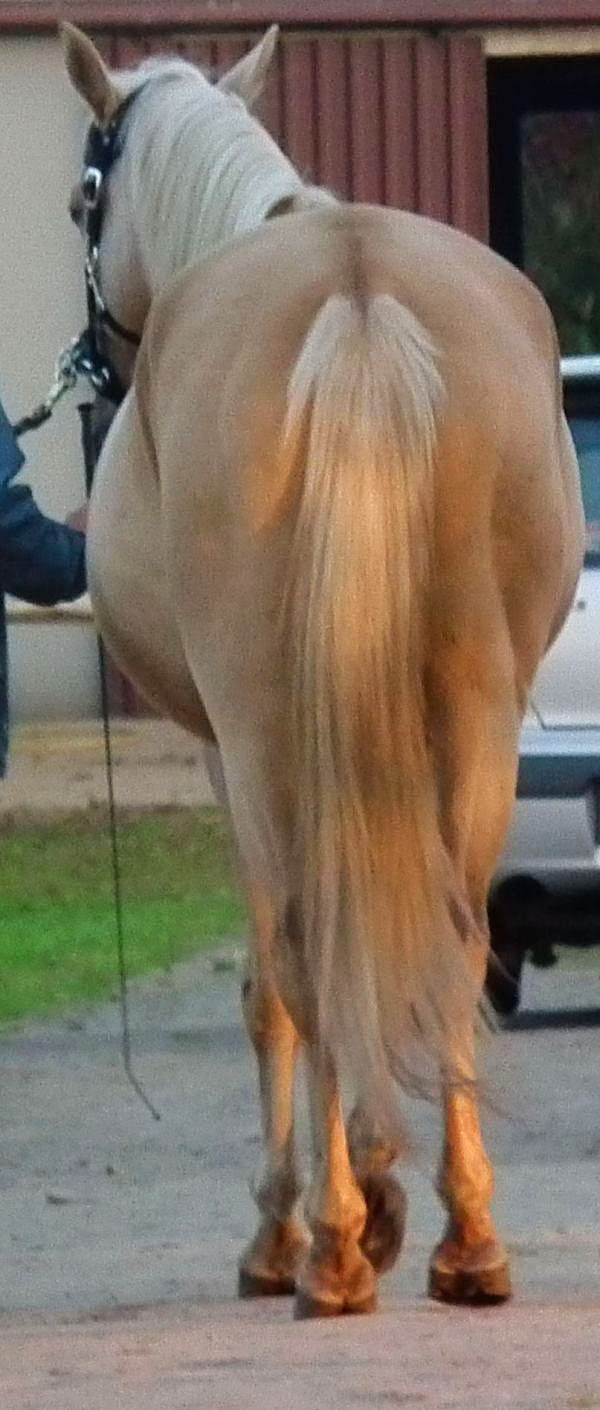
After watching the video, again some things have occured to me. I've noticed that Karina's hindquarter muscles were very tense – they were clearly visible. That told me what a hard work that short training session has been for her. That told me also how weak her hindleg muscles are and how slow and careful my work on that must be. And that explained to me why our sholder forward beginnings are so hard and why Karina, who is usually so eager to work on new things, rebelled against that exercise. I knew that there might be some trouble with that exercise, therefore I didn't dare to ask her to bend more and work on shoulder in yet. Maybe I should move to LFS on circle in trot, before I move on to shoulder in. But somehow I thought that way it would be easier.

Update: Now that I've watched more Marijke's videos and read more about the shoulder in exercise in dr Heuschmann's books and Marijke's ebooks, I know that I'm on the right track. But we need to work more on lateral bending, as it is the starting point of the LFS, and everything other will improve.

20/10/2013

ST Session - September 29th

The weather finally was nice. But everywhere around the stable there is just horrible mud, the horses sink into it especially near the pasture gate, where the earth is trampled. I met Karina grazing on the bank of the ditch, together with a playful gelding. She refused to come to me in the direction where he stood, so I moved to the other side and there she came to me. She didn't like walking through the mud, but she seemed quite happy about going to work. I squeezed her through a tiny opening in the gate, because the gelding was waiting for the opportunity to bolt through the opening, so I had to be careful. Karina waited for me at the other side of the gate and together we went to the stableyard. I groomed her and I've noticed that, though now she is spending nights in the stable, she seems not to be laying herself for the sleep (or the straw in her stall is just exceptionally clean) and she started to eat the straw again. I don't know what it means, she has more than enough hay (there is always some left). Maybe the hay is just too sweet and she needs more fibre.
Anyway, I groomed her as usual, she pawed a little, but stopped at my request and started playing with the rope. I put a cavesson on and we went for a walk to do some warming up. I asked her to lower her head and take a little stelling while walking straight, so we tried a little shoulder forward exercise. Karina started chewing and licking, so it seemed to me that she actually liked it. After the walk I wanted to work a little on the poles and cavalettis, to engage her hind legs a little, but as nothing was prepared, we just walked over some poles (Karina rushed on them a little – was she scared or eager?) and went to the roundpen to work on our ST.
This time I paid more attention to the inside hind leg movement. The whole procedure, together with a little warm up in a standstill, took about four minutes. I think that was optimal, because Karina had no time to get bored or tired with my excess requests. I changed directions a lot and gave Karina carrots (of course, only when I was satisfied with the quality of her LFS) to keep her motivated. She accepted those little treats with cold dignity, which is so characteristic for her, now when she is not hungry anymore...
After I watched the video from the training, I've noticed all the mistakes I've made. I should have asked Karina to take more stelling, I've left her head without cavesson control. I should have worked on bigger circles to the right, as Karina tends to fall on her right front leg. But we're making progress, and a big one: after the ST session, Karina's back was lifted and slightly rounded in the loins. The difference was stunning, and yet I know that it is going to be better still. Also this time Karina didn't resist to the cavesson pressure and she didn't push back on it, as could be visible in our previous video (her upper neck muscles were hard and tense). This time her neck was pretty loose and relaxed. She didn't chew or lick during the ST, but this is still to come when she relaxes more. I just can't wait for our next training, I'm planning to do some exercises on poles to warm up and engage the hindquarters.
After we finished working in the roundpen, I worked a little on her obedience: I opened the roundpen gate and stood there for a moment. Usually Karina is very eager to leave it, but this time she just stood beside me relaxed and waiting for me to give her directions. Then we went back to the stableyard, but suddenly Karina stopped halfway there and didn't want to come. That was pretty strange. In fact, there was the new horse grazing beside the roundpen and maybe she just wanted to join him. I asked her to come with me to the stableyard anyway and there I dressed her up in her halter and we went back to the roundpen to graze. The other horse was gone now, but Karina was happy enough with the beautiful grass that was growing there. Afterwards we went back to stable. I decided not to massage her and I just led her to the pasture. She didn't want to go, because that awful mud was everywhere around the gate. I asked her to go anyway, and led her over a harder ground and then I left her with her mates in the pasture.

16/10/2013

Cavesson for the First Time - September 22nd

It stopped raining, and all the horses were in the pasture again. The grass is becoming worse and worse, but they use it while they still can. They have started to change their coat. Autumn is coming...
I took Karina along with other horse from the pasture, so I cannot really say that she followed me, because she might have been following her mate. I groomed her as usual, and at that time she played with her lead rope, pulling at it with her teeth. This is her new habit and I can't tell for the moment what does it mean. Is she angry, bored, frustrated, impatient or just playful? Sometimes it seems to me that she is irritated or impatient, because she paws the ground with her front leg. That habit seemed to be gone, and recently it returned, I can't really tell why. Anyway, this time she quickly stopped doing that, because I introduced cavesson to her and she was curious what it was. I showed her how it worked, and at first she tried to force its pressure, but she quickly realised that I wanted her to lower her head. Karina knows that when I put my fingers to her poll I'm asking her to lower her head. I used that reaction to explain to her how cavesson works. And I must admit that it is a wonderful tool. It prevents the horse from tilting its head sideways, it keeps the head perfectly straight. While using the rope halter I had to be extremely careful with the head position. Cavesson saves me that trouble.
I had to remind Karina, that if I'm asking her to lower her head, she must remain thus until I ask her to lift the head. It works now worse than in the previous training, but I'm not worried about that, because Karina must get used to the cavesson and different work routine. Anyway, about the training: I overdid it. Karina offered me much and I failed to see when I passed her limits. I pushed her too far. I'm afraid that next time she won't be that eager to train. I failed to pay enough attention to every detail. However, this is our first real ST session and I could hardly have hoped to succeed at every point. Fortunately, this time I had camera with me, so I can watch the training video and analyze it thoroughly. I also compared this video with some of Marijke's – especially those with Prince Elmelund. They are mighty inspiring, because they show the complete beginnings of ST. Prince, however, was at that time an unbroken horse, while Karina has had a lot of bad training in the previous years. She has a lot of bad habits and it will take much time to repair it by slowly rebalancing her and making her carry herself with ease and grace. I know that she has it in her, and it is my task to make her realise it.
It was really hard for Karina to start moving in a totally different way. She stayed focused and paid a lot of attention to my directions. That was so sweet of her, she is such a willing and obedient horse. In the last two minutes of training she could focus no more and I have noticed that, but unfortunately not quick enough. Analyzing our video further, I have also noticed that I should really pay much more attention to the inside hind leg movement – Karina tends to place her leg just beside her body, not underneath her point of weight. I kept on touching her obliquus abdominis muscle with my riding whip, and it worked great – she started putting her leg more towards her weight point, but now it seems to me that I was not precise and persistent enough. Sometimes I touched her hind leg joints, to show Karina that I wanted her to close her joints more. Though we worked in a standstill and walk only, the training was indeed hard and Karina was tired in the end. And mentally she was just exhausted. I have to work more on my attention to such details, I have to notice such things immediately. I want Karina to be interested and focused on what we are doing, and under no circumstances I want to force her to do anything. I wish I could train more often, but at present I can't. That is the cause why I'm trying to squeeze out of every minute of training all I can. Five minutes up to three, four times a week is so little... But I really need to chill out a bit.
It seemed to me after the training, that I asked too much of Karina, when I asked stelling on a small circle. I worked much more on a big circle (and again I've made a mistake there – I shouldn't work so close to the fence, because the horse may be reluctant to bend) And when I watched Marijke's videos, I have noticed that it was all right. Karina now and then tries to avoid bending her body as asked, and sometimes she walks sideways, keeping her body perfectly straight (or at least as straight as her crookedness allows). She tends to fall on her inside shoulder (more on the right side), but now I think that I know how to prevent it...
After the training I took Karina for a walk through the fields. I worked a little on lowering her head, leading, stopping and backing up. Then we went to see the tent which recently was built up in the stableyard. Karina seemed to be really interested in it, she peeped curiously inside it. Then I gave her a massage of neck muscles, which she seemed not to like (I must stop doing massage for some time, as she seems not to be very happy with any kind of massage, even that with her plastic brush, which she always enjoyed). Then I washed her legs, and for the first time she was completely relaxed during that procedure.
At last I took her to a place where the grass is always greener than in the pasture ;) A couple of minutes grazing and away she went to join her herd.
Finally, as to the the photos: in the three of them you see Karina doing LFS on a circle for the first time. In the first picture, you see Karina trying to bend her body laterally. She is stepping under her point of mass with her inner hind leg, she is keeping her head pretty low and forward. She is leaning very much on me, and is not on her own legs yet. In the second photo Karina is resisting the cavesson pressure, as you may notice – her upper neck muscles are very tense. But soon she yielded to that pressure and she released the muscle tension and lowered her head, allowed it to just hang freely on the nuchal ligament. And in the third photo there is Karina dragging her feet behind her, just after a couple of minutes of ST. That showed me how hard work it is for a horse to change long years habits, to change her way of moving. And may I always keep that in mind, before I ask Karina to do more...

15/10/2013

Relations First - September 17th

The weather was just horrible. It was raining for the last couple of days, and it was  cold and dark. It was only late in the afternoon that we chanced to catch a glimpse of the autumn sun. Karina was locked up in the stable along with other horses. They are used to being outside 24/7, so they weren't particularly happy about being locked up like this. They had, however, a lot of good hay and straw, and they were chewing it laborously :) I took Karina outside, and again I had a feeling that at that moment she didn't like it to have me around. Nonetheless, I groomed her and dressed her up in her new harness (she used to be a harness horse, and I'm trying to work on that a little, too) just to see if it will fit her. She is not entirely used to this type of harness, so I suppose it will take us some time to work it through, but she didn't protest anyway. Then I took it off her and tied her a rope halter, so that we could move on to our Straightness Training. On our way to the roundpen I worked on some elements, such as stopping, leading and backing up. In the roundpen I shortly warmed her up on the longe line in walk and trot, because she spent last 12 hours in the stall. Then I reminded her stelling in a standstill, which she performs just beautifully.
Karina seems to be a little disturbed by our new work routine. We play a lot and we work in hand only. I think she doesn't see my point yet, she is used to completely another working routine, and that seems to be causing her to feel insecure. It showed very vividly when I asked her to walk through a puddle of water in our riding arena. She had to choose either to walk through the water or to trample me down. Karina stood there for a while, thinking intensively, and finally she chose a third possibility: she jumped over the puddle and started galloping around me. She was terrified. It took me some time to calm her down and then we walked through the water together. I was surprised to see her so frightened. I have been a little harsh with her that day and that may have affected her, too. But as soon as I walked into he water, she followed me without any hesitation. I stopped her in the middle of the puddle and petted her to show her that the terrifying puddle was actually a nice place.
Then we went back to the stableyard and went to graze some time together. I noticed that Karina kept her distance nicely and as I approached she moved calmly away. She no longer had anything against me being so close and she followed my every step and answered to any pressure I put on her. When I think about our beginnings, when sometimes it happened that Karina showed me very clearly that she didn't want me around, now it is completely different. She is calm and relaxed, only sometimes, I think after some changes in the herd hierarchy, she tries some of her tricks on me. Of course that it is all useless, and she seems to realise it also, because such things happen less and less often. I know that this just happens and I'm ready to answer it properly, I am no longer upset by it. In the world of the horse nothing ever is exactly the same as it was yesterday, and as soon as I discovered that truth I stopped worrying that one day everything was just perfect, and the next day it was a horror. We no longer have such violent ups and downs, our communication is far more subtle. And it is so important to have fun here and now, to enjoy the moment whatever it is. If it is wonderful – what more do I need, and if it is horrible – what does it tell me? What can I learn from that? I remain calm and keep on pondering on that until I reach some conclusion. If Karina is not in the mood for any hard work, we just hang out together. We go for a walk through the fields, go grazing together. Our relations are always in the first place, and her physical training is not that important. If we miss one of our training days, what does it matter? But if I forced her through it, I could lose it all.

14/10/2013

Am I the Problem?

There are numerous publications which tell of problems in a horse's body caused by an improper riding. Thinking that I caused Karina's problems, I stopped riding and focused on a groundwork and longeing, especially on a longeing in free canter, which is supposed to cause the release of tensions in the back muscles. So I longed and longed and waited for a miracle, which didn't happen. Karina seemed to be quite relaxed, her tail was relaxed and her breathing also, her eyes soft and friendly, but she would never lower her head, do whatever I would. Poles and cavaletti didn't help much, even longeing on hills didn't help also. Maybe she needed more time to relax, but yet I knew that sometimes she would go with her head just above the ground, in trot and canter even. It has clearly showed me that she was able to do that, but I could do nothing to maintain this. I tried different tricks, such as stopping the training immediately, hoping that she will remember what she did to make me stop the training and she'll offer me that the next time herself. I used this method on different occasions and it worked perfectly, but not this time. I know that without relaxation there is no further work and I was at a loss what to do. I tried riding again, hoping that I might help her to relax from the saddle, but it soon turned out that my weight (which is a little above 55 kilos) was causing her pain. She started running, carrying her head extremely high, bucking and kicking her belly. I could not ride. I was terrified. I had Karina examined by a specialist, who found out that nothing was wrong with her skeleton and muscles. Her back was OK and her legs and neck also. I knew exactly when did the problems begin, but that didn't help us much. I still didn't know what to do to set everything right. Fortunately, now I finally know...

12/10/2013

Dimensions of Karina's Asymmetry

I've watched Marijke's videos where she works with some other people's horses and it seems to me that she is moving with the basic ST exercises quite fast. Sometimes she starts to work on shoulder-in on the very first day. On the other hand, I've seen her work with some extremely crooked horses veeery slowly, even slower than I work with Karina. And now I'm not sure whether Karina's way of moving justifies my extreme caution. In fact she is sometimes able to move with her head forward-down in trot and canter even, she doesn't put too much weight on her front legs, she is able to engage her haunches and free the shoulders - a little, of course, but the improvement may come in time. What worries me actually, is that there exists some visible stiffnes in one of the hind legs and that Karina is diagonally imbalanced. Her left front leg is also more developed, her left shoulder is much bigger than the right one. There are problems with the lateral bend, because on the longe she often moves to the left and is bent to the right, with her right side muscles tense and hollow and she should be moving with her righ side long and round. I have worked with her on long reins, but that doesn't work exactly as I wished, because when the outside rein is behind her haunches, she keeps on hurting her mouth with every step. But when the outside rein is thrown across her back it really works fine and prevents her from falling out through her outside shoulder. But then it doesn't prevent the hips from falling out, and even the wall of the roundpen is not enough. Before I bought Karina, she in fact has never worked on the longe properly, and she never walked on the longe to the right at all. The former owner told me that she didn't want to go to the right, so he never forced her to. But she soon learned that she can move to the right also (I didn't force her, too - I just asked a few steps at first, then one circle, then another and another), though there are still problems with the bending and so on, but I don't expect them to magically disappear after so many long years that causing them took. It is wonderful that I finally found in the meanders of the Internet materials, which explained to me so much and helped me to name and define the problem. Because how could I work on a problem if I didn't know what it actually was?